
EV charging cable theft is the act of cutting and removing the charging cord from an electric vehicle charger, usually to sell the copper inside for scrap. For convenience stores, gas stations, and charging station operators, it has become a real business concern. The copper in a single fast-charge cable may be worth $25 to $150 to a thief, while the cost to the business that owns the charger can run into the thousands. Strong EV charging station security protects charging infrastructure on site and helps law enforcement identify the people responsible after a theft.
Key Takeaways
- EV charging cable theft is a form of copper theft, and a single theft can take less than two minutes at a publicly accessible site.
- EV charging cable theft costs go well beyond the cable. 3Si estimates total incident costs at $5,700 to $18,500.
- Cameras, lighting, and charger alarms help deter theft, but they do not capture criminals once a cable is taken. Ending repeat theft patterns requires catching the people responsible.
- GPS tracking, verification, and a trusted pathway to police dispatch give business owners a way to help law enforcement locate stolen cables.
Why EV Charging Cable Theft Is a Growing Concern
Thieves target EV charging cables because of the copper inside them. Fast-charge cables carry more copper than standard cords, and public charging stations often sit in open lots accessible around the clock. The copper scrap value per cable is modest, and a single EV charger cable theft can take less than two minutes.
Major charging networks have seen the impact. Bloomberg reported that Electrify America had 215 charging cords cut in 2024 as of September, up from 79 over the same period the year before. ChargePoint said four in five of its vandalism cases involved cut cords.
For businesses operating DC fast chargers, the infrastructure security risk is concentrated, and thieves often hit more than one charger at a time. In Houston, the Associated Press reported that one charging station lost 18 of its 19 cords. Theft patterns like these tend to continue until the people responsible are caught.
The Financial and Operational Costs of Stolen EV Charging Cables
How much does EV charging cable theft cost? Based on 3Si estimates, the EV charging cable replacement cost and repair work for a single fast-charge cable runs $2,000 to $7,700. Once outages and operating expenses are included, the total cost of EV charging cable theft can reach $5,700 to $18,500 per incident.
Restoring service can require a site visit, labor, permits, equipment replacement, and follow-up work. Beyond those repair expenses, long lead times on high-power cables can keep a port offline, and the operational costs grow as charger downtime cuts into charging revenue.
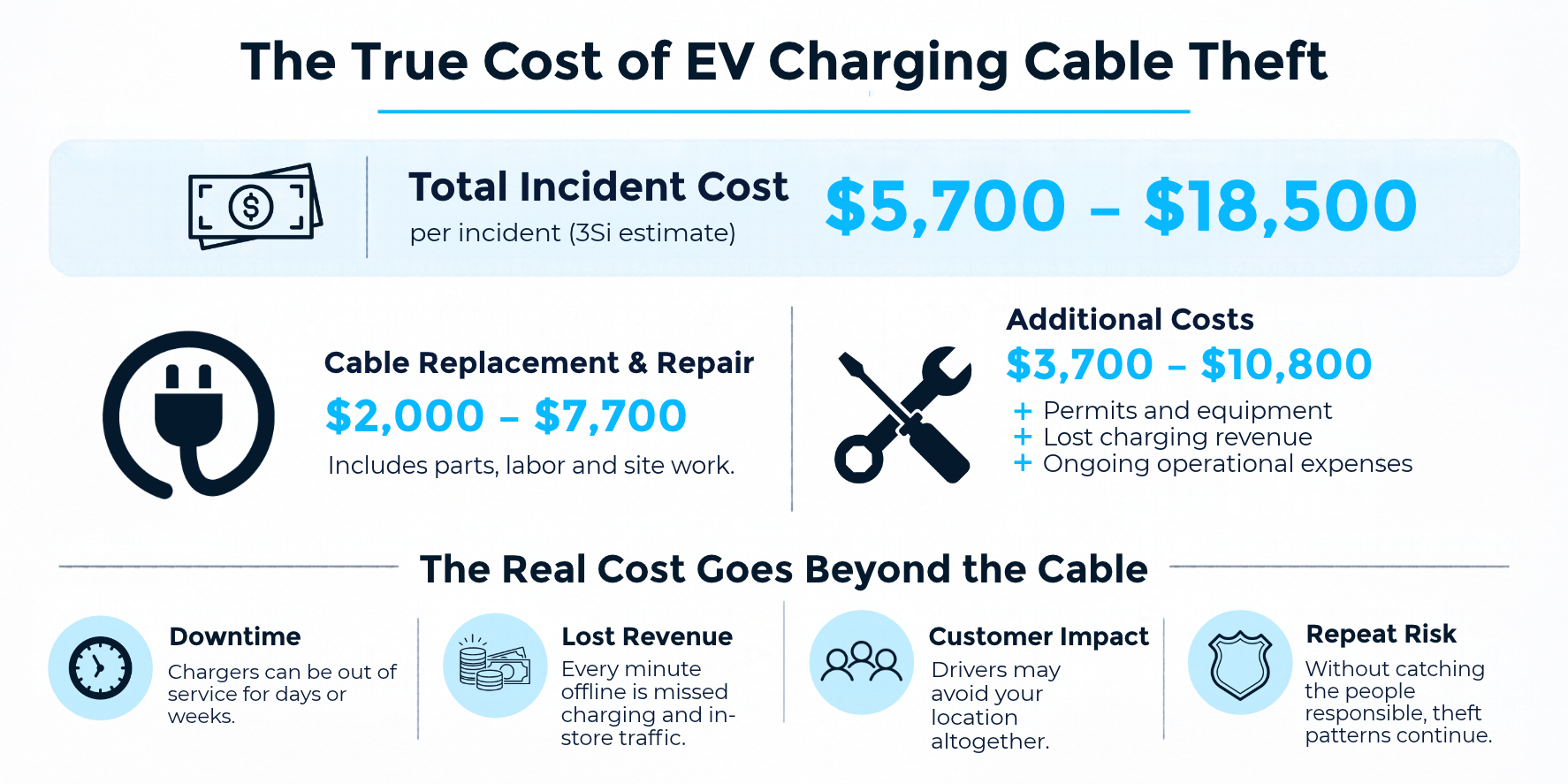
Charging availability also shapes the customer experience. J.D. Power data cited by Bloomberg found nearly one in five public charging attempts failed in the first half of 2024, with about 10% of those failures tied to a damaged or missing cable. For gas stations and convenience stores, an offline charger can mean a driver who never comes inside.
| Direct Costs | Operational Consequences |
|---|---|
| Cable replacement and repair | Charger downtime while parts are sourced |
| Site visits and technician labor | Lost charging revenue |
| Permits and replacement parts | Missed in-store visits from EV drivers |
| Follow-up work | Ongoing risk if the site remains a target |
EV Charging Cable Theft Prevention and Security Strategies
How can operators protect EV charging cables? Effective EV charging cable theft prevention uses more than one layer:
- Surveillance cameras covering each charger and the approach to it.
- Lighting that keeps charging areas visible after dark.
- Physical cable protection, such as clamps, that helps deter or slow an attempt.
- Charger alarms that alert operators to tampering.
- GPS tracking that helps locate a cable if it is taken.
Charging networks are adding these layers too. In 2025, ChargePoint introduced cut-resistant cables and an alarm that can notify owners by text or email.
Each layer plays a different role in EV charging station security. Cameras, lighting, and alarms support theft deterrence and document what happens on site, while physical security measures make an attempt harder. Preventative measures help protect the site, and GPS tracking is what helps capture criminals after a theft. It follows a stolen cable once it leaves the property and gives law enforcement location data to help make an arrest.
EV charger cable theft protection needs to extend beyond the charger. Can stolen EV charging cables be tracked with GPS? Yes, protect the EV Charging device by attaching a covert GPS device to the charging station. Asset tracking makes stolen cable tracking possible as the asset moves.
3Si HardCase XT: GPS Tracking for EV Charging Cable Theft
3Si’s EV charging cable tracking solution helps extend protection beyond the charger. Built on 3Si’s ORC Tracker in the new, rain-resistant HardCase XT, the solution attaches a GPS tracking device directly to the charging cable, enabling GPS asset tracking if the cable is stolen.
Can stolen EV charging cables be tracked? With an EV charging cable GPS tracker in place, yes, though best practice is to choose a GPS tracker that allows for multiple signal coverage like GPS, GNSS, cellular and Wi-Fi to ensure the device continues to transmit in all scenarios. Location data lets operators follow the asset once it’s gone and supports law enforcement in making an arrest. EV charger cable tracking is one part of 3Si’s layered approach:
- Protect: Physical protection and site security measures help deter or slow an attempt.
- Track: GPS tracking helps identify stolen cable location if it is taken.
- Verify: 3Si’s team can help escalate an alert and establish incident information, supporting incident verification.
- Dispatch: For verified incidents requiring law enforcement response, DirectToDispatch™ is designed to deliver verified incident details and location to local police dispatch, working with existing systems and workflows.
For charging station operators, this approach supports a more informed response, strengthens charging infrastructure security, and helps address theft patterns at their source.
Protecting EV Charging Infrastructure from Cable Theft
The impact of EV charging cable theft lasts well after the cable is gone, through repair costs, charger downtime, and lost revenue. Effective EV charging cable theft prevention combines physical security, monitoring, and GPS tracking so asset protection doesn’t stop at the property line. Deterrence protects the site, and tracking supports incident response by helping law enforcement catch those responsible and stop repeat theft. 3Si’s EV charging cable tracking solution supports that layered EV charging station security strategy for convenience stores, gas stations, and charging station operators.
Take the next step in protecting your EV charging infrastructure
Connect with our team to learn how 3Si’s GPS tracking solutions can support your cable theft prevention strategy – Contact 3Si
For additional information on EV charging cable theft costs and 3Si’s approach to protection, view the EV Charging Cable Theft Factsheet.
FAQs About EV Charging Cable Theft
Why are EV charging cables targeted by thieves?
Thieves target EV charging cables for the copper inside, which can be sold as scrap. 3Si estimates the copper in a fast-charge cable is worth $25 to $150 to a thief.
How much does it cost to replace a stolen EV charging cable?
Based on 3Si estimates, replacing and repairing a single fast-charge cable costs $2,000 to $7,700. Including outages and operating expenses, total incident costs can reach $5,700 to $18,500.
What security measures help protect EV charging cables?
Effective protection combines surveillance cameras, lighting, charger alarms, physical cable protection such as clamps, and GPS tracking, which supports recovery after a cable is taken.
Can GPS tracking help locate stolen EV charging cables?
Yes, if a GPS tracker is attached before a theft. Results depend on the device and operating conditions, but location data can support recovery efforts and help law enforcement make an arrest.
What should gas station and convenience store owners consider when securing EV charging stations?
Owners should weigh the EV charging cable theft risks to charger availability, repair costs, and customer experience. A complete plan covers on-site protection, tracking, and a verified pathway to police dispatch.
What is included in 3Si’s EV charging cable tracking solution?
The solution pairs 3Si’s ORC Tracker, housed in the new rain-resistant HardCase XT, with an EV Charger Clamp Accessory that attaches it to the charging cable and adds a physical layer of protection at the charger. If a cable is stolen, GPS tracking helps identify its location, and DirectToDispatch™ is designed to deliver verified incident details to local police dispatch.


 Charlie Erickson


 Joseph Courtesis

 Jason Lockett