

For retail loss prevention executives managing high-risk footprints, passive security measures are no longer enough to counter violent retail theft. Traditional alarm systems often burden store associates during an active crisis, distracting them from personal safety. Achieving true operational readiness requires a proactive shift toward automated connectivity that delivers immediate scene information directly to local agencies, transforming the post-incident timeline.
In a recent customer case study, convenience retailer United Pacific shared how combining covert asset tracking with verified intelligence helped strengthen its approach to employee safety and incident response. Rather than relying on unverified alarms or expecting employees to recall critical details after a traumatic event, the company implemented a workflow that delivers verified, real-time information directly to law enforcement to support a more informed response.
Key Takeaways
- Supporting Employee Safety: Direct to dispatch intelligence workflows reduce the burden on store associates during an active incident by helping verified information reach law enforcement without relying solely on employee reporting.
- Rigorous Workforce Training: The success of the retailer’s program relies on comprehensive employee training regarding asset tracking protocols.
- Actionable Investigative Intelligence: Specialized tracking solutions help provide verified location data and incident details that can support investigations and improve coordination with responding officers.
- Works with Existing Dispatch Workflows: Verified intelligence is delivered through established public safety communications, helping agencies respond without requiring significant technology changes.
Detection and Verification Inside the Retail Security Workflow
For asset protection leaders, an effective retail security monitoring workflow depends entirely on moving past unverified alarms. Traditional security measures frequently trigger false alerts, which stretch police resources thin and delay critical responses. To solve this, the retailer implemented a strict, layered security event verification retail protocol to ensure that every alert transmitted represents a confirmed, active incident.
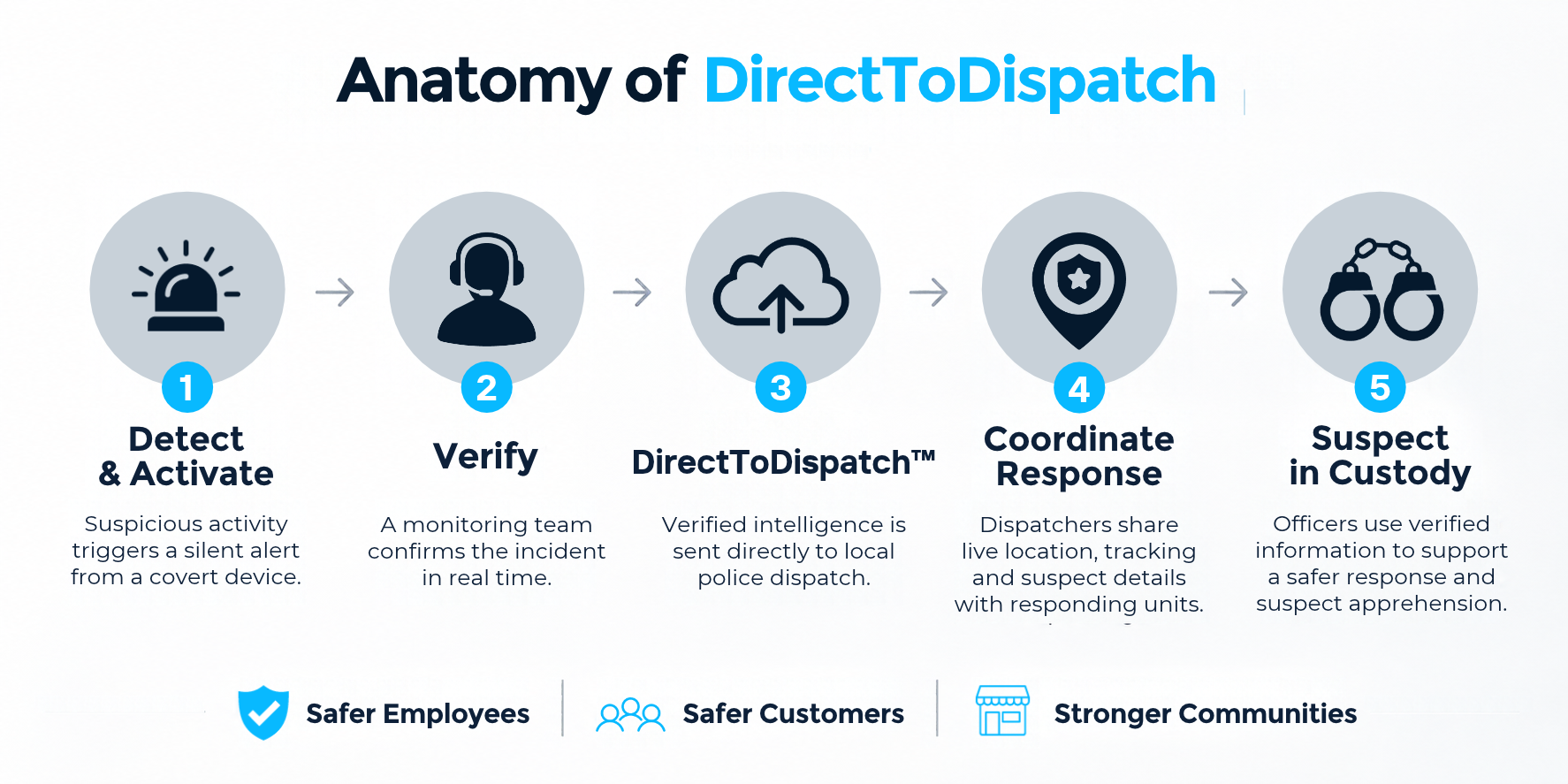
The standard operational progression follows a distinct sequence. It begins with suspicious activity or unauthorized asset movement, which triggers a silent device activation.
From there, the event moves through an automated verification process managed by dedicated monitoring teams to ensure real-time visibility before initiating direct routing.
This layered verification process helps ensure that only confirmed incidents are escalated, providing greater confidence for both the retailer and responding law enforcement while reducing unnecessary dispatches.
How Dispatch Ready Intelligence Reaches Law Enforcement
Once a covert tracking device is activated, verified incident information is automatically shared with the appropriate public safety communications center. This reduces reliance on manual reporting during a high-stress event while providing dispatchers with timely, actionable information to support response decisions. Instead of forcing a store associate to find a phone and describe a chaotic scene under pressure, the system populates dispatch-ready intelligence directly into the local police communication infrastructure. This automated stream provides a direct channel for real-time retail crime reporting without requiring heavy software integrations.
This verified data is transmitted directly to the dispatchers responsible for routing active field units. The automated stream delivers actionable details, including live location updates, directional tracking, and vehicle descriptions if a suspect flees.
This provides dispatchers with excellent situational awareness to coordinate field responses strategically. By automating this process, the technology ensures that local law enforcement receives critical scene information while working alongside existing department protocols.
The Role of Law Enforcement During a Verified Crime in Progress
During an active robbery or burglary, the strength of a law enforcement retail partnership is critical. When an officer responds to a standard retail theft, they are often working with minimal, delayed, or conflicting information. Direct intelligence workflows change this dynamic entirely by establishing clear coordination between retail security assets and police dispatch teams without disrupting local department protocols.
- Strategic Response: Because the incident is pre-verified, dispatchers can route units efficiently using accurate data.
- Tactical Positioning: Officers receive live updates regarding the suspect’s exact travel path, allowing them to set up ahead of the target safely.
- Enhanced Scene Safety: Knowing the specific parameters of the incident helps officers adjust their response planning, protecting responding units and the general public.
The value of this coordinated approach was demonstrated during a recent armed robbery at one of the retailer’s locations. After a covert tracking device was transferred to the suspects, verified location information was shared directly with police dispatch. Responding officers received live updates throughout the incident, allowing them to coordinate their response and safely apprehend the suspects.
The retailer noted that local law enforcement later encouraged broader deployment of the technology based on the operational value it provided during active investigations.
How Actionable Intelligence Supports Better Decision-Making
For asset protection leaders, establishing immediate operational awareness is vital for safeguarding frontline employees and managing corporate assets during a security breach. Relying on delayed reports or generic alarm notifications prevents security executives from making informed decisions. Implementing an automated direct routing pathway solves this challenge by delivering actionable crime intelligence directly to security stakeholders.
This specialized crime intelligence provides critical incident context, helping teams understand how an event unfolds in real time. During an organized retail crime response, this visibility allows corporate teams to work alongside store managers safely.
Security leaders can confidently protect employee safety, preserve physical evidence, and manage risk, making it an approach that any peer retailer experiencing repetitive theft or burglary can implement within their own organization.
Outcome: From Detection to Suspect in Custody
A successful retail security incident response is measured by concrete results that scale across an organization. According to United Pacific, the program produced measurable operational improvements across its retail footprint, demonstrating the value of combining employee training with verified GPS intelligence and direct to police dispatch workflows. Rather than broad industry generalizations, these specific figures detail one retailer’s success in protecting a 622 store footprint.
Customer Reported Performance Metrics
| Reported Operational Area | Customer Reported Outcome |
|---|---|
| Tracked Event Apprehension | 75%+ suspect apprehension rate on tracked events |
| Workplace Safety Claims | 0 reported stress-related workers’ compensation claims from crimes involving the 3Si tracking device |
| Crime Reduction | 80% reduction in crime year-over-year |
While results will vary by organization, these customer-reported outcomes demonstrate how verified intelligence can help improve incident response, support employee safety, and contribute to long-term crime reduction strategies.
Conclusion
Modern retail security requires more than alarm notification—it requires verified information that helps the right people make informed decisions as an incident unfolds.
United Pacific’s experience demonstrates how combining employee training, covert asset tracking, and direct to police dispatch intelligence can help improve coordination between retailers and law enforcement. By reducing reliance on manual reporting and providing verified situational awareness, organizations can better support employee safety while enabling a more effective response.
For retailers facing repeat robberies, organized retail crime, or high-risk incidents, verified intelligence offers a practical way to strengthen security operations without disrupting existing emergency response processes.
Learn more about retail security solutions tailored to your organization’s footprint or or contact our experts to discuss your specific security challenges.
FAQ
1. How does automated technology improve a standard retail security incident response?
In a standard retail security incident response, business owners usually report a theft long after the suspect has left the premises. Direct dispatch pathways automate this process by transferring live, verified data to local authorities as the event unfolds. This workflow provides arriving units with maximum tactical context.
2. Why is comprehensive employee training featured in a successful retail crime case study?
A retail crime case study shows that security solutions are only as effective as the workforce operating them. Training frontline staff to handle retail security assets properly ensures they can navigate high-stress situations safely. Keeping security operations confidential also prevents internal collusion and deters external bad actors.
3. Does this tracking method require direct integration with internal police systems?
No. The platform operates via direct interoperability, delivering dispatch-ready intelligence into the existing communication frameworks that law enforcement agencies already use. It requires no invasive IT overhauls or software merges with municipal emergency networks.
4. What role does verification play when establishing a connection to a police dispatch retail theft team?
When a business establishes a direct connection to a police dispatch retail theft team, filtering out false alarms is mandatory. Monitoring teams evaluate active alerts instantly to confirm verified incidents before routing the live tracking data straight to dispatch logs. This verification process ensures that public resources are deployed only to active crime scenes.



 Joseph Courtesis

 Jason Lockett

 Ben Tucker